
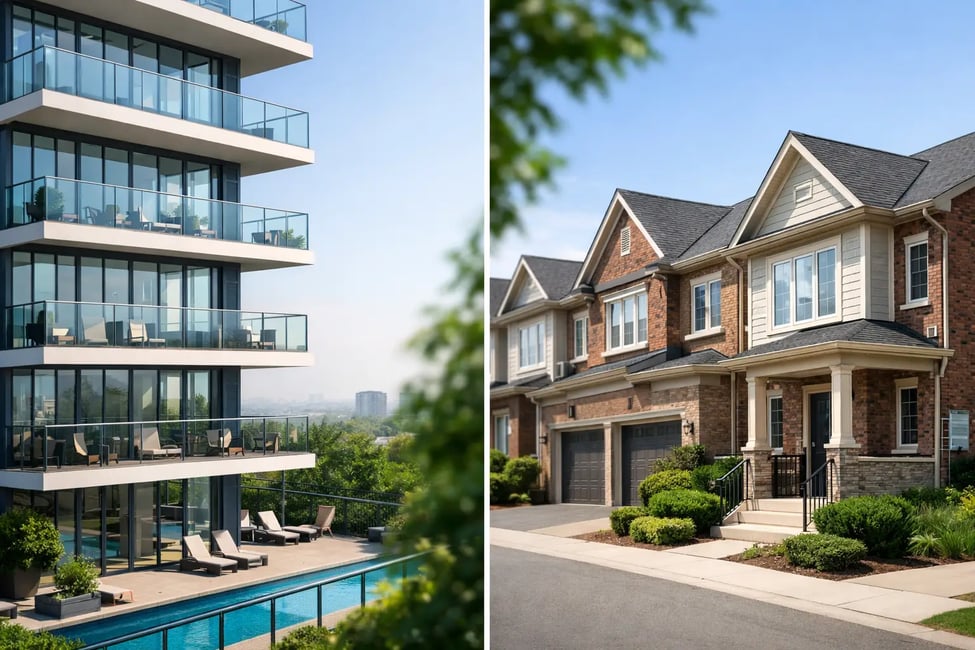
If you're trying to choose between condo versus townhouse ownership, you're probably not just comparing floor plans - you're trying to picture your actual day-to-day life. I see this a lot with first-time buyers in Langley and nearby communities: one option looks more affordable on paper, while the other feels more like a long-term fit. The right choice usually comes down to how you want to live, what monthly costs you can comfortably carry, and how much flexibility you want over time.
This is one of those decisions where the details matter more than the label. A well-run condo in Willoughby can be a stronger buy than an aging townhouse with rising maintenance issues, while a townhouse in Walnut Grove may suit a growing family far better than a smaller condo closer to transit. I always tell buyers to look past the brochure and ask what ownership will actually feel like after move-in day.
Condo versus townhouse ownership: the real difference
At a basic level, condos usually mean a private interior unit within a larger building, while townhouses typically offer multiple levels, a direct entrance, and more separation from neighbors. But from a buyer's perspective, the more meaningful difference is how space, maintenance, and control are divided.
With a condo, you're usually buying less square footage but gaining convenience. Exterior maintenance, building systems, landscaping, and shared amenities are often handled collectively through the strata. That can be a relief if you want a lower-maintenance lifestyle or if you're buying your first home and don't want every repair to become your problem.
With a townhouse, you generally get more room, more privacy, and a layout that feels closer to a detached home. That extra space often comes with trade-offs. There may still be strata fees and rules, but the cost of ownership can be shaped by things like roofing, fencing, exterior repairs, and the age of the complex. You're not fully on your own the way you would be in a detached house, but you're also not living with the same lock-and-leave simplicity many condo buyers want.
What matters most for first-time buyers
For a lot of first-time buyers, affordability gets the first vote. In many Fraser Valley markets, condos are the more accessible entry point because the purchase price is lower. That can mean a smaller down payment, a lower mortgage amount, and an easier path into ownership.
But monthly affordability is where buyers need to slow down. A condo with a lower purchase price can still feel expensive if strata fees are high, parking is limited, and you need to budget for future special levies. On the townhouse side, the mortgage may be higher, but the added space can reduce the chance that you'll outgrow the home quickly. If you're planning to stay put for several years, that matters.
I often walk buyers through a simple question: are you trying to get into the market as efficiently as possible, or are you trying to buy a home that can carry you through your next life stage? Neither answer is wrong, but they point to different properties.
Lifestyle fit is where the choice usually becomes clear
The financial side matters, but lifestyle is what usually breaks the tie.
If you like being close to shops, transit, restaurants, or a shorter commute, a condo may make more sense. In places where newer condo developments are clustered near amenities, buyers often appreciate being able to walk more and drive less. For busy professionals or single buyers, that convenience can outweigh the smaller footprint.
Townhouses tend to appeal more to buyers who want functional family space. Extra bedrooms, a small yard, attached parking, and room for storage can make daily life much easier. In neighborhoods like Murrayville or parts of Walnut Grove, that layout often works well for young families, buyers with pets, or anyone simply tired of sharing hallways and elevators.
There's also the question of noise and privacy. Condos can be excellent, especially in concrete buildings, but in many developments you'll still share walls, common entrances, and amenity spaces more closely than you would in a townhouse. Some buyers don't mind that at all. Others know right away they want their own front door and fewer shared spaces.
Costs beyond the purchase price
This is where condo versus townhouse ownership deserves a closer look. Buyers often compare asking prices but miss the ownership costs that show up after completion.
Strata fees are the obvious example. Condo fees may cover more building services and amenities, but they can climb as buildings age or operating costs rise. Townhouse strata fees can be lower in some complexes, but that doesn't automatically make them a better value. You need to understand what those fees actually cover, what the contingency reserve fund looks like, and whether the strata has deferred important maintenance.
Insurance is another factor. In recent years, strata insurance costs have been a real issue in parts of BC, and those increases can affect monthly fees. Utility costs can also differ. A condo may be more efficient to heat, while a larger townhouse may cost more month to month simply because there's more space.
Then there are special levies. These can affect both condos and townhouses. If a building envelope, balconies, windows, roofs, or shared infrastructure need major work, owners may be asked to contribute. That's why I always encourage buyers to read strata documents carefully rather than treating them like paperwork to rush through.
Resale potential depends on the buyer pool
A lot of buyers ask which property type is the better investment. The honest answer is that it depends on location, condition, strata health, and who the likely next buyer will be.
Condos often attract a broad buyer pool because they tend to be more affordable. That can help with resale, especially in areas where first-time buyers and investors stay active. A condo in a well-located, well-managed building may hold demand very well, particularly if it has practical features like parking, storage, and a usable floor plan.
Townhouses often appeal to a different stage of buyer - people moving up from condos, young families, and buyers priced out of detached homes. In many suburban communities, that demand can be very strong because townhouses offer a middle ground that buyers really want. When inventory is tight, a good townhouse can move quickly.
What I look at is not just property type, but product quality. Is the layout functional? Is the complex well maintained? Does the location make sense for the likely future buyer? A beautiful unit in the wrong building or a larger home in a poorly run strata can still underperform.
The strata question you should not ignore
Whether you're buying a condo or townhouse, the strata matters more than many first-time buyers realize.
I don't just mean the monthly fee. I mean how the complex is run, whether the council seems proactive, how owners have handled maintenance, and whether there are restrictions that may affect your plans. Pet bylaws, rental restrictions, age restrictions, renovation rules, and parking policies can all shape how livable the property feels.
This becomes especially important if you're buying with future flexibility in mind. Maybe you think you'll live there for five years but may want to keep it as a rental later. Maybe you have a dog now, or you plan to start a family. Those details are easy to overlook when a home shows well, but they matter just as much as the kitchen finishes.
Which one makes more sense in today's market?
Market conditions always influence this decision. When borrowing costs are higher, buyers tend to watch monthly payments more closely, which can make condos look attractive. When townhouse supply is limited in family-oriented areas, competition can push values up because buyers see them as the closest alternative to detached homes.
In practical terms, I advise buyers to compare options within the same budget rather than in separate categories. If your budget tops out at a certain number, what does that actually buy you in a condo versus a townhouse right now? In some pockets of Langley, the difference may be dramatic. In others, the townhouse option may be older or farther from amenities, while the condo option is newer and better located.
That side-by-side comparison usually tells the real story. You're not choosing an abstract property type. You're choosing between specific homes, in specific neighborhoods, with specific costs and compromises.
How I help buyers make the call
When clients are stuck between the two, I bring it back to a few practical questions. How long do you expect to stay? What monthly payment feels comfortable, not just technically approved? How much space do you need now, and how much might you need in three to five years? How important are privacy, outdoor space, commute, and resale flexibility?
Once those answers are clear, the path usually gets easier. My job isn't to push you toward the bigger purchase or the fastest decision. It's to help you understand what fits your lifestyle, your budget, and the realities of the local market so you can buy with confidence instead of second-guessing yourself later.
If you're weighing condo versus townhouse ownership, the best choice is the one that still feels right after the excitement of the showing wears off - when you look at the numbers, the strata documents, and the life you want to build there.